
For New Zealand businesses, international freight is essential to moving goods into and out of the country. Available airline capacity, direct-route frequency and connections through regional hubs all influence what businesses pay. Magellan Logistics has supported New Zealand clients since 2015, with an Auckland team coordinating air freight across its international network.
Air freight is the fastest option for time-sensitive cargo, but the pricing can feel opaque. This guide explains the key factors that affect air freight rates and how New Zealand importers and exporters can manage their air freight costs effectively.
How Are Air Freight Rates Calculated?
Air freight pricing starts with a base rate applied to your shipment’s chargeable weight. Understanding how chargeable weight is calculated is the single most important factor in determining the cost of air freight for your specific cargo.
Carriers calculate air-freight chargeable weight using the higher of actual weight and volumetric weight. The conventional calculation is cubic metres × 167, equivalent to multiplying length × width × height in centimetres and dividing by 6,000.
Actual Weight vs. Volumetric Weight
For example, 20 cartons weighing 8 kg each have an actual weight of 160 kg. At 40 × 40 × 40 cm per carton, their combined volume is 1.28 cubic metres, producing a volumetric weight of approximately 214 kg. The shipment is therefore charged at approximately 214 kg. Express and courier operators may use a different divisor, so confirm the calculation basis with the carrier or forwarder.
This is the primary driver of air freight cost per kg for light but bulky cargo such as textiles, electronics, and packaged consumer goods. Reviewing your packaging dimensions before booking can meaningfully reduce the factors that affect your shipment’s air freight rates.
What Surcharges Are Added on Top of the Base Rate?
The base rate is only one part of the final invoice, with fuel, security, terminal handling, screening and any special handling charges all shaping the total landed cost.
Fuel surcharges are set by carriers and can change with the applicable fuel index, route and billing period. Rather than assuming a fixed percentage, compare the current fuel surcharge together with the base rate and other carrier charges for the specific booking.
Common Surcharges to Budget For
Other common surcharges include:
- Security surcharge (mandatory for all international flights)
- Terminal handling charges (applied at origin and destination airports)
- Screening and X-ray fees
- Dangerous goods or perishables surcharge (where applicable)
These air shipping costs vary by carrier and route, so comparing total landed cost rather than base rate alone gives a more accurate picture.
Which Other Factors Influence Air Cargo Pricing?
Beyond weight and surcharges, route, available capacity, service frequency and demand affect air freight pricing. Shipments that require a connection through another hub may cost more or take longer than freight moving on a direct service.
Cargo type also affects pricing. Dangerous goods, pharmaceuticals, and perishables require specialist handling and attract premiums. Standard general cargo moves at the most competitive rates.
Trade Lane and Seasonality
For New Zealand shippers, Auckland Airport (AKL) is the primary air cargo hub. Many international routes require a connection through Sydney or Singapore, which adds transit time and can influence air freight rates on specific lanes.
Demand can rise before major manufacturing shutdowns and year-end retail peaks, but the timing and rate impact vary by trade lane. Planning regular shipments early and comparing contract and spot options can reduce exposure to peak-period capacity constraints.
How Can NZ Businesses Reduce Their Air Freight Costs?
Several practical strategies can help New Zealand businesses manage air freight costs without compromising on service or transit reliability.
Packaging, Consolidation and Carrier Relationships
The most direct way to reduce air freight pricing is to right-size your packaging. Reducing the volumetric footprint of bulky goods can lower chargeable weight and materially cut air cargo rates.
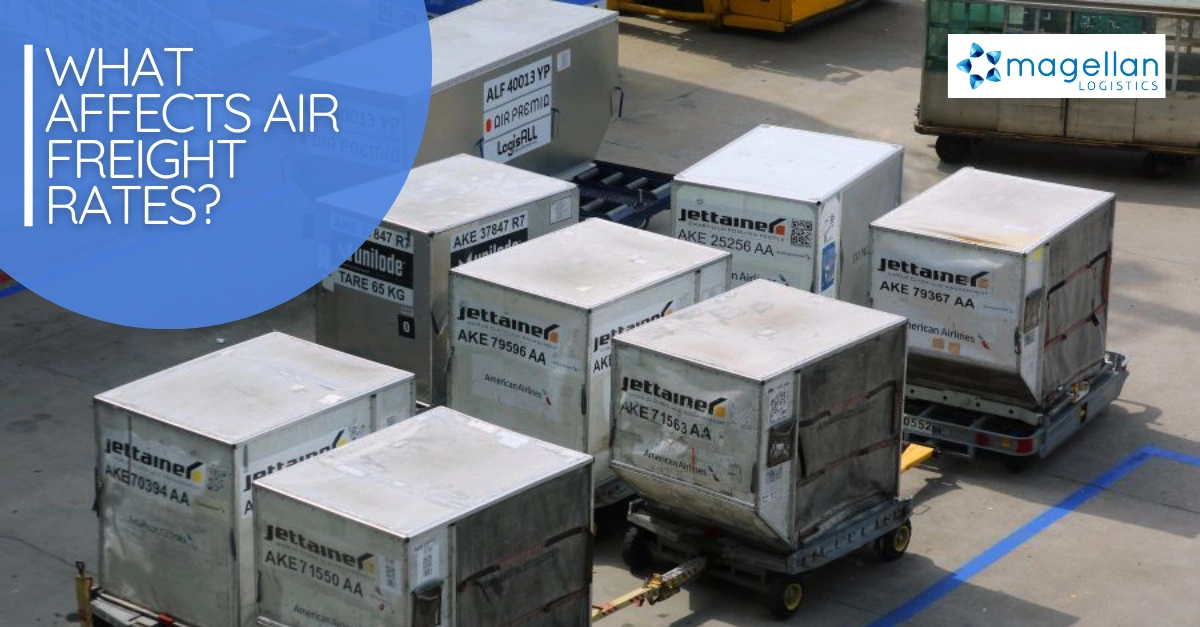
Beyond packaging, consolidation is worth exploring for smaller shipments that do not fill a full unit load device. Magellan Logistics can combine your cargo with compatible freight to reduce per-unit air shipping costs on the same lane.
Working with a freight forwarder that maintains carrier relationships gives you access to negotiated rates that are typically not available on open-quote platforms. The MagTrack digital portal provides real-time visibility into your shipment status and freight spend, making it easier to identify patterns and plan more cost-efficient booking windows.
Frequently Asked Questions About Air Freight Rates
How much does air freight cost per kg from New Zealand?
Air freight rates from New Zealand vary widely by destination, season, cargo profile and available capacity, so the most reliable cost guide is a current quote based on your shipment details. China and Australia routes tend to be more competitive; US and European routes attract higher base rates due to distance and limited direct connections from AKL.
Why do air freight rates change so frequently?
Air freight rates are driven by fuel costs, carrier capacity, and global demand. Fuel indices update monthly, capacity shifts with airline schedules, and demand peaks seasonally. This volatility is why working with a freight forwarder who actively monitors market conditions can reduce your exposure to unexpected air cargo rate spikes.
Is air freight cheaper than sea freight for small shipments?
For time-critical or high-value cargo, air freight can offer better total cost once warehousing and inventory carrying costs are factored in. For large or lower-value shipments, sea freight remains significantly cheaper per cubic metre. A dedicated account manager at Magellan Logistics can help you identify which mode best fits your cargo profile and timeline.
Partner with Magellan Logistics
Magellan Logistics has supported New Zealand businesses since 2015, with an Auckland team coordinating air freight and an accredited brokerage partner handling customs clearance requirements. Whether you are planning regular shipments or managing a time-sensitive consignment, we can help you assess the route, service and chargeable-weight factors that shape the total cost.
Speak to an expert at Magellan Logistics to discuss your air freight needs. For a complete air shipping solution including customs brokerage and door-to-door delivery, explore our door-to-door air freight guide.