
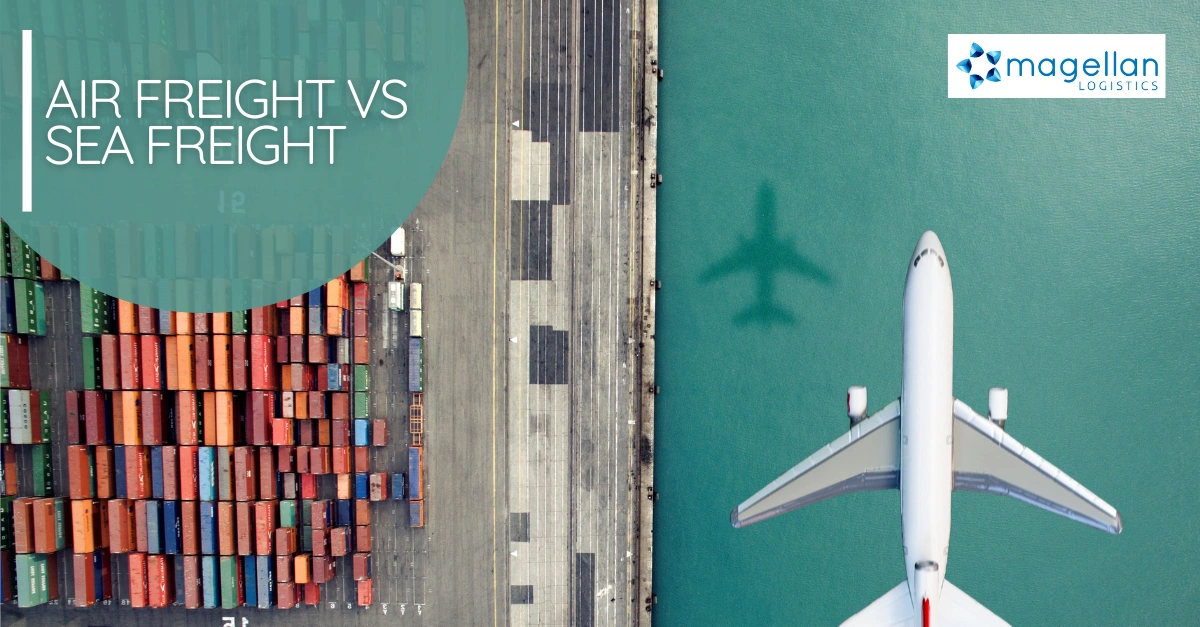
Every New Zealand business trading internationally faces the same fundamental question: do you pay for speed, or plan for savings? The air freight vs sea freight decision shapes your supply chain costs, inventory levels, and ability to meet customer deadlines. For over 10 years, Magellan Logistics has helped NZ businesses navigate this choice, drawing on deep expertise in both freight modes and NZ Customs compliance, as well as MPI biosecurity requirements.
This guide breaks down the air freight vs sea freight comparison across cost, transit time, and compliance so you can make the right call for your business.
Cost Comparison: Air Freight vs Sea Freight
The cost gap between air and sea is significant. Air freight is priced by weight or volume, whichever is greater, and typically runs several times higher per kilogram than sea freight. For most shipments, sea freight LCL (less-than-container load) delivers substantial savings, and that air freight vs sea freight cost difference compounds quickly at scale.
Sea freight also offers FCL (full container load) rates for high-volume shippers, which can push costs well below LCL pricing. LCL is generally suited to shipments above 2–3 cubic metres; smaller parcels often work better via air.
Hidden Costs to Factor In
Air freight charges are based on volumetric weight, calculated by multiplying the shipment’s total volume in cubic metres by 167. For example, 20 cartons each measuring 40cm × 40cm × 40cm produce a volumetric weight of 214kg, which exceeds their actual combined weight of 160kg, so the volumetric figure would be charged. Bulky but lightweight items can cost significantly more than their actual weight suggests.
Sea freight carries its own additional charges: port handling, wharfage, and demurrage if your cargo sits unclaimed. NZ Customs Service clearance fees apply to both modes. Total landed cost, not just freight rate, is what matters.
How Do Transit Times Compare Between Air and Sea?
When to use air freight often comes down to your timeline. Air freight is fast: Shanghai to Auckland typically in 2-4 days, London in 5-7 days. Sea freight takes considerably longer, ranging from around 20-30 days from Asia to 35–45 days from Europe. For urgent stock replenishment or seasonal peaks, air is hard to replace.
Sea freight offers steadier scheduling on fixed weekly routes. However, air capacity can tighten during peak periods or due to aircraft availability, so neither mode is entirely immune to delays.
Planning Around Sea Freight Lead Times
Port congestion and canal delays (Suez and Panama) can unpredictably extend sea freight timelines. For inventory planning, longer lead times via sea freight demand accurate forecasting. Missed forecasts lead to costly air freight rescues or excess stock.
Environmental Impact and NZ Compliance
Sea freight’s carbon footprint is dramatically lower, roughly 40–50 times less per tonne-km than air. For NZ businesses with sustainability commitments, the air vs ocean freight carbon gap is a meaningful factor in any shipping decision.
NZ regulatory requirements add another dimension to any air vs ocean freight decision. NZ Customs Service clearance is required for both modes, but sea freight at wharves and air imports at Auckland Airport follow different protocols.
MPI Biosecurity and Customs Clearance
Ministry for Primary Industries (MPI) biosecurity screening applies to both modes, and is particularly critical for food, plant, and animal products. MPI processing can extend timelines beyond the published transit window. NZ Customs compliance ensures your shipment is prepared correctly before it arrives.
When Should You Use Air Freight?
Choosing air or sea freight often comes down to urgency and cargo value. In the air freight vs sea freight decision, air wins when timelines are non-negotiable, cargo value justifies the premium, or inventory delays would cost more than the air freight surcharge.
Cargo Types That Suit Air
Air freight suits electronics, pharmaceuticals, luxury goods, and perishable exports where quality depends on speed. Shipments under 500 kg, time-critical spare parts, and trend-sensitive apparel also benefit from air freight. Chilled air freight preserves product quality where sea transit times risk spoilage.
When Does Sea Freight Make More Sense?
When to ship by sea is a straightforward calculation when volume and timeline align. Sea freight wins the air/sea freight comparison on cost for most regular bulk shipments. Sea freight suits your business when shipment volume exceeds LCL minimums, the timeline allows 3–6 weeks from order to door, and the cargo is robust and non-perishable.
Volume and Cost Thresholds
NZ manufacturers and wholesalers regularly source from China, Thailand, and India by sea because cost savings, often 80–90% compared to air, support profitability. Regular shipments via sea freight also smooth cash flow compared to reactive air-freight emergencies. For businesses that need the speed of air freight but want to reduce their environmental impact, Magellan’s carbon offset freight programme offers a practical alternative.
Frequently Asked Questions
Many NZ businesses resolve the air freight vs sea freight question by running both modes together. Below are the questions the Magellan Logistics team hears most often when helping clients make their decision.
Is air freight ever cheaper than sea freight?
Rarely. For very small, urgent shipments, air can occasionally compete on total cost. In most cases, sea freight holds a clear advantage in any air freight sea freight comparison.
How long does NZ Customs clearance add to my timeline?
Allow 24–48 hours for standard air imports and 24–72 hours for sea freight. MPI screening can extend timelines unpredictably. Preparing documentation in advance minimises delays.
Can I combine air and sea freight for the same order?
Yes. Splitting a shipment, with urgent items via air and volume via sea, is a practical way to balance cost and risk when choosing air or sea freight for the same order.
What’s the best option for exporting NZ primary products overseas?
Chilled air freight suits premium, perishable products where freshness matters. Sea freight is preferred for bulk commodity exports where volume economics outweigh transit time.
The air freight vs sea freight decision involves more than a rate comparison. It touches NZ Customs compliance, MPI requirements, and supply chain visibility. Magellan Logistics brings over 10 years of NZ-based expertise and a global partner network spanning 270+ locations to help you make the right call, every time.
A dedicated account manager can coordinate both freight streams, ensuring NZ Customs clearance aligns with your arrival schedule.
Speak to an expert and let’s start a conversation about the right shipping solution for your business.